In 1983, Steve Jobs stood before the International Design Conference and talked about books. Specifically, he talked about Aristotle. He said that when he was at school, books had kept him out of trouble – that he could read what Aristotle wrote without needing an intermediary. Then he said something that, four decades later, reads as a precise description of what large language models actually do.
The footage, released by the Steve Jobs Archive in 2024, shows a 28-year-old Jobs articulating a vision of computers that could hold the knowledge of great thinkers and answer questions about it directly. He was not describing a search engine. He was describing what we now call generative AI.
It was not a one-off remark. Jobs returned to the same idea two years later.
The Aristotle vision, 1985
In a 1985 speech, Jobs described personal computing as having “tremendous momentum” and predicted it would soon enable an era of what he called “free intellectual energy.” He told his audience that computers would someday gather source material and help people ask questions of the world’s greatest minds – both living and dead.
To illustrate the point, he mentioned that Aristotle had once tutored Alexander the Great, and that he felt jealous of that access. Then he stated his ambition plainly.
My hope is someday when the next Aristotle is alive, we can capture the underlying worldview of that Aristotle in a computer.
That sentence describes, with reasonable precision, what an LLM trained on a philosopher’s complete works is now capable of doing. Jobs said it forty years before it existed.
Knowledge Navigator, 1987
Four years after the 1983 speech, Apple produced a concept video under then-CEO John Sculley called Knowledge Navigator. The video depicted a tablet computer with a conversational AI assistant – a digital agent that could hold a natural language dialogue, retrieve information, and help the user accomplish complex tasks.
It was a precise conceptual sketch of what Siri would attempt to be 24 years later, and what Apple Intelligence is attempting to deliver now. The video was not a product. It was a statement of direction, and the direction was unambiguous: Apple believed the future of computing was conversational and intelligent.
Bicycle for the mind
Jobs’ most quoted idea about technology was his description of computers as a “bicycle for the mind.” The metaphor came from his observation that a condor – nature’s most efficient traveller – was beaten in energy efficiency per mile by a human on a bicycle. The computer, in Jobs’ framing, was that bicycle: a tool that amplifies human cognitive capability rather than replacing it.
The framing matters because it places Jobs firmly in the augmentation camp, not the automation camp. He was not interested in machines that did things instead of humans. He was interested in machines that let humans do things they could not do alone. That distinction shapes how Apple has always positioned its AI work, from Siri through to Apple Intelligence.
The Siri acquisition, 2010
In February 2010, a company called Siri, Inc. launched a voice assistant app on the App Store. It had been built by Adam Cheyer, Dag Kittlaus, and Tom Gruber, who had spent the better part of two decades developing natural language interface technology at SRI International before spinning it out commercially.
Within two to three weeks of the app going live, Jobs called the company’s office unannounced. He wanted to buy it.
The founders declined the first approach. They had just raised a funding round and had no interest in selling. Jobs came back. In April 2010, Apple acquired Siri, Inc. for a reported sum of more than $200 million. Jobs had personally driven the acquisition.
At the D8 Conference in June 2010, Walt Mossberg asked Jobs about the deal, referring to Siri as a search company. Jobs corrected him immediately.
They’re not a search company. They’re an AI company. We have no plans to go into the search business. We don’t care about it – other people do it well.
That clarification is significant. In 2010, before ChatGPT, before the transformer architecture dominated public discourse, Jobs was explicitly framing a major acquisition in AI terms. He was not buying a voice interface. He was buying an AI company, and he said so on the record.
One day before he died
On October 4, 2011, Apple held an event to launch the iPhone 4S. The headline feature was Siri, now integrated directly into iOS. Jobs had resigned as CEO six weeks earlier due to his illness, but had remained involved in major decisions. He had overseen the Siri integration and the direction it was taking.
Steve Jobs died on October 5, 2011 – one day after the iPhone 4S launch. The last major product decision of his life was to put an AI assistant on a mobile phone and ship it to the world.
What Apple did next
Siri launched to mixed reviews. It recognised voice and handled basic tasks but fell short of what the Knowledge Navigator video had suggested Apple believed was possible. Through the 2010s, it lost ground to Google Assistant and later to the generation of large language model-based assistants that arrived after 2022.
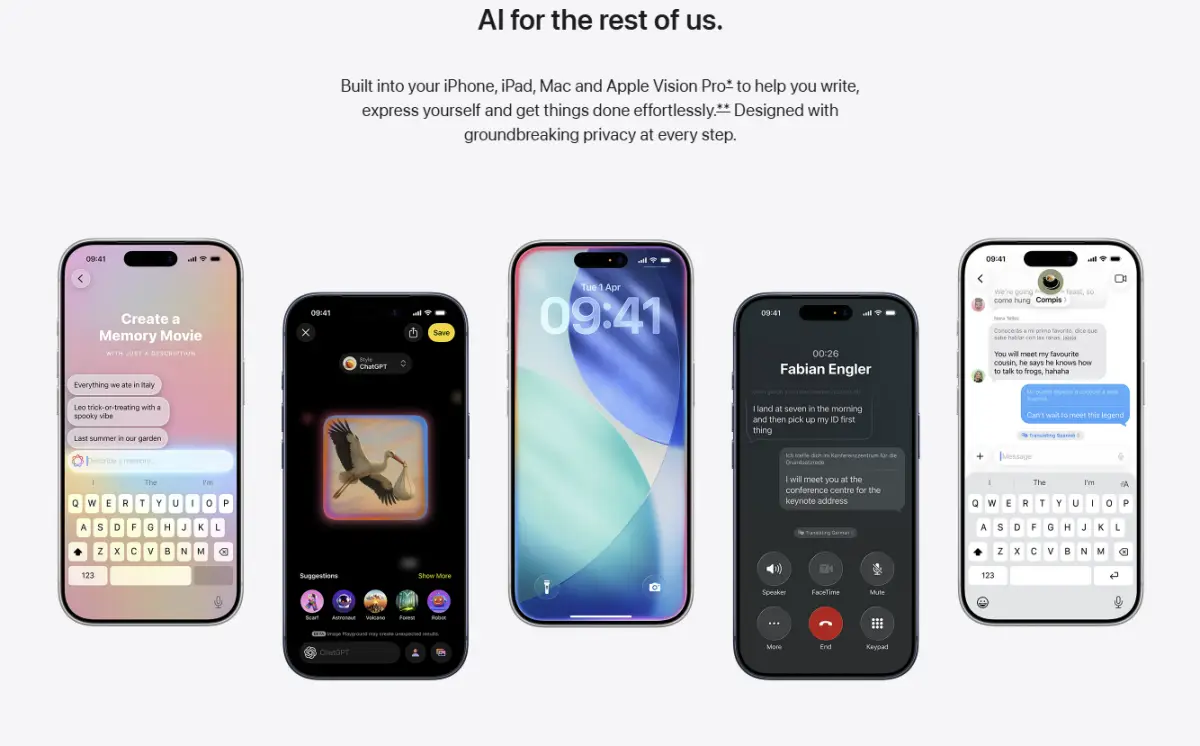
Apple announced Apple Intelligence at WWDC in June 2024, describing it as AI woven into iOS, iPadOS, and macOS. The marketing phrase was “AI for the rest of us” – a deliberate echo of the original Macintosh slogan from 1984. The features include enhanced Siri capabilities, writing tools, image generation, and an integration with OpenAI’s ChatGPT for queries requiring broader knowledge.
The rollout has been uneven. Some promised features shipped late or were pulled. The ChatGPT integration has raised questions about privacy. The gap between announcement and delivery has attracted criticism that Apple, for all its careful positioning, has struggled to execute on AI in the way it has executed on hardware.
The through-line
What the record shows is that Jobs was not surprised by AI. From the 1983 Design Conference speech to the 1985 Aristotle quote to the Knowledge Navigator video to the Siri acquisition, there is a consistent thread: Jobs believed that the future of computing was a machine that could understand human language, hold knowledge, and respond intelligently.
He used the word AI explicitly when talking about Siri. He framed the acquisition in AI terms, not voice terms, not search terms. He put that AI on a phone and shipped it the day before he died.
Whether Apple Intelligence eventually delivers on the vision Jobs articulated in 1983 is an open question. The vision itself was never in doubt.

John Moore is the editor of fastai.news, an independent publication covering developments in artificial intelligence.
He founded fastai.news in April 2026 to apply the same rigorous, neutral reporting standards he established at Powerboat News – his international publication – to the fast-moving world of AI.
With no filler and no opinion, fastai.news reports what is happening in AI models, research, business and tools, and leaves readers to draw their own conclusions.
John is based in Buckinghamshire, England.